

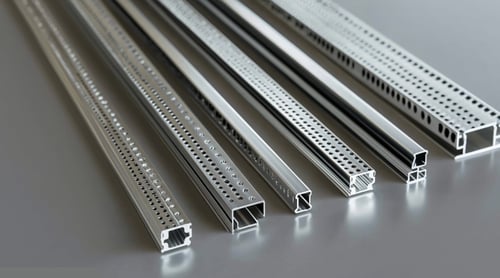
Aluminum Micro Drilling: Extreme Precision On Custom Extruded Profiles
Profall extrudes standard and custom aluminum profiles and can also deliver them curved, ready to install. In this article, we explain how calendering works, when it makes more sense than bending, and which profiles can be curved.
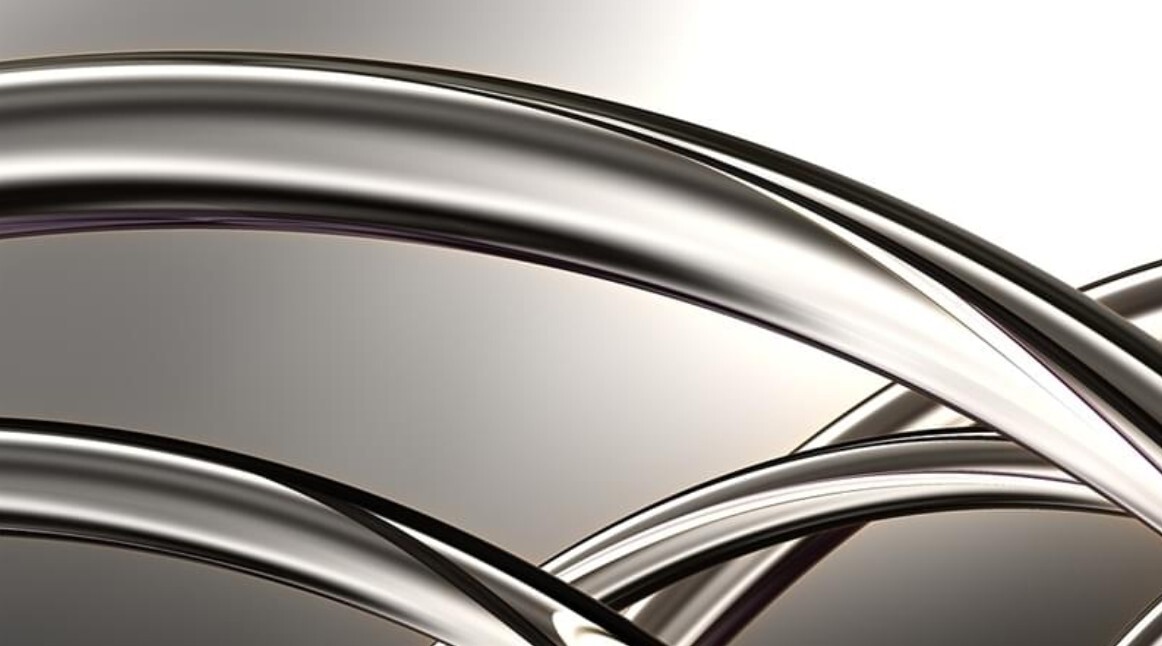
An arched facade, a handrail that follows a spiral staircase, a round frame for a contract furniture counter. Behind each of these shapes is a straight profile that becomes curved without losing precision: that is the job of aluminum profile calendering.
In this article, you will learn:
- What calendering is and how it works on aluminum profiles
- Calendering vs. bending: when to choose one or the other
- Which aluminum profiles can be calendered
- Industrial applications of aluminum profile calendering
- Profall's calendering service: from extrusion to a ready-to-use curved profile
What calendering is and how it works on aluminum profiles
Calendering, also known as roll bending, is a cold forming process. The profile passes through a set of rolls, usually three, arranged in a pyramid. Two act as supports, while the third pushes on the profile and forces it to curve.
The curve is formed by running the profile back and forth through the rolls, and with each pass the operator moves the pressure roll closer. The radius decreases gradually until it reaches the design value. The rolls have a groove contoured to the profile's cross-section, which supports the walls during forming and preserves their geometry.
The result can be:
- an arc with a constant radius;
- a full circle;
- a curve with a variable radius, such as an ellipse or an "S" shape;
- a spiral or a helix, using dedicated tooling.
The difference compared to traditional bending lies in how the metal is deformed. Bending concentrates the deformation at a single point and creates an angle. Calendering spreads it along the entire length of the arc and produces a continuous curve with no sharp corners.
Why aluminum is well suited to calendering
Aluminum is a ductile metal. It can be cold formed without cracking, especially in 6000 series alloys such as 6060, which we use for many of our curved profiles.
There is one phenomenon to manage: springback. When the profile leaves the rolls, it tends to open up slightly. With gradual passes and proper roll setup, springback is compensated for and the required radius is achieved, part after part.
Calendering vs. bending: when to choose one or the other
Calendering and bending are often confused, but they solve different problems. The right choice depends on the final shape and the radius you need.
Choose calendering when:
- you need large radii or continuous arcs, from a few dozen centimeters (about a foot) to several meters;
- the curve must be uniform along its entire length;
- you need to produce full circles, segmental arches, or variable-radius curves;
- appearance matters and you want to avoid localized deformation marks.
Choose bending when:
- you need a sharp angle or a very tight radius;
- the deformation is limited to one specific point on the part;
- you need to make frames, brackets, or angled connectors.
Calendering also offers repeatability. Once the parameters are set, the roll bender reproduces the same radius across the entire production run. This is essential when you need to assemble multiple curved elements together, such as the modules of a facade.
Which aluminum profiles can be calendered?
Almost all extruded profiles can be calendered. What changes is the minimum achievable radius and the level of care the process requires.
Open profiles
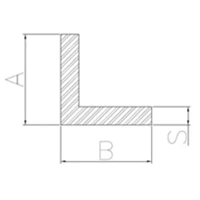
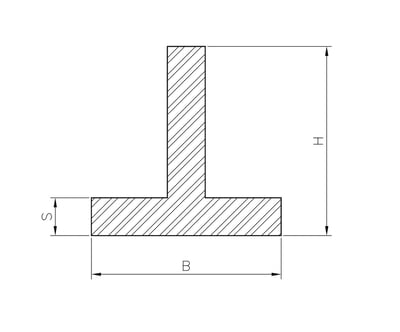
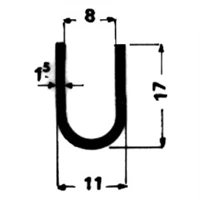
L-angles, U-channels, T-profiles, and C-channels are among the easiest to calender: their open cross-section adapts well to contoured rolls.
What matters, however, is the direction of the curve. An angle can be bent with one leg facing the inside or the outside of the arc, and its behavior changes significantly. That is why the bending direction should be defined at the design stage.
Closed profiles
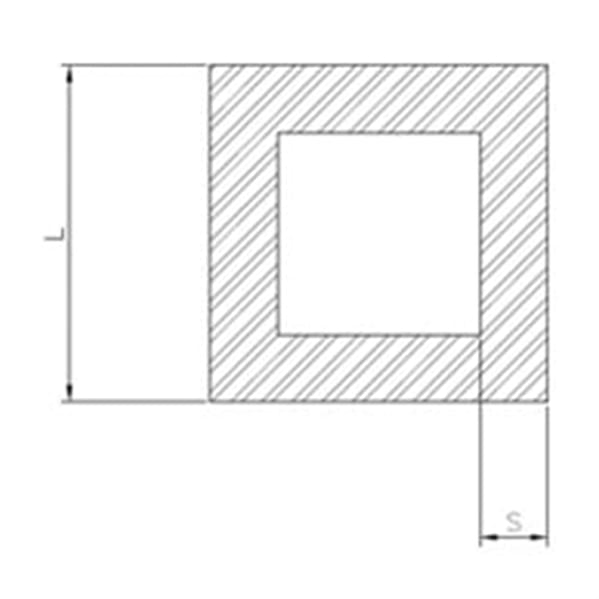
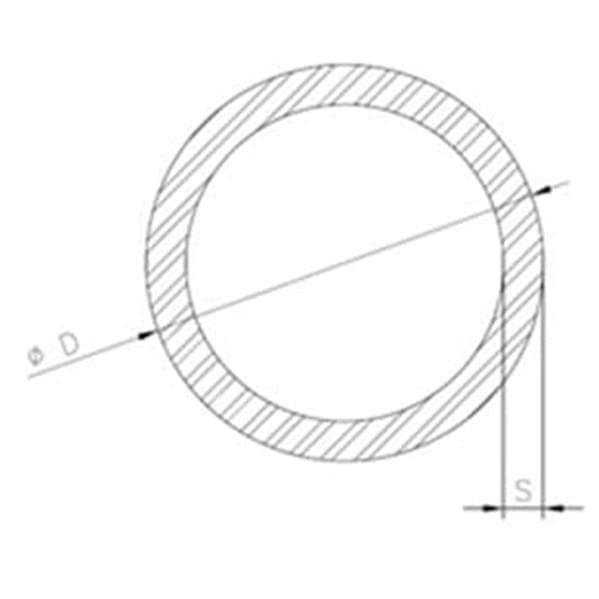
Square tubes, rectangular tubes, and round tubes require more attention. During bending, the walls tend to collapse inward or become oval.
With rectangular tubing, orientation also plays a role. Bending "the easy way," across the short side, is simpler than bending "the hard way," across the long side.
Custom profiles with complex cross-sections
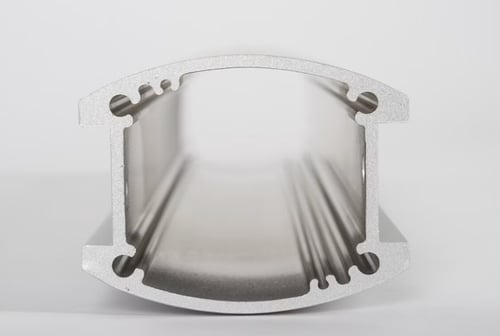
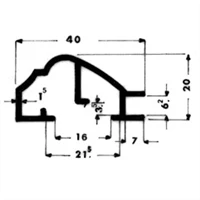
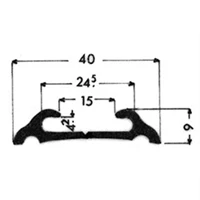
90% of our production is dedicated to custom profiles: special U-channels, frames, vehicle trim, stair handrails, and cross-sections designed from scratch.
These profiles can be calendered too, but each cross-section must be evaluated individually. Asymmetrical sections tend to twist during bending, and rolls contoured to the specific profile are often required.
Looking for more curved solutions? Read our article on curved aluminum extrusions.
Technical limits to consider
The minimum radius is not a fixed value. It depends on several factors:
- section height in the bending plane: the taller the section, the larger the radius must be;
- wall thickness: walls that are too thin risk wrinkling on the inner side and thinning on the outer side;
- alloy and temper, which determine the material's ductility;
- section symmetry, which affects stability during processing.
That is why it pays to design the profile knowing from the start that it will be curved. We can adjust wall thickness and geometry from the very beginning, avoiding problems during calendering.
Industrial applications of aluminum profile calendering
With a curved profile, you can create shapes that a straight profile cannot achieve. These are the industries where calendering makes the biggest difference.
Architecture and construction
- Curved curtain walls.
- Arched windows and doors, and round-top windows.
- Canopies, roofing, and cladding with soft lines.
- Handrails for spiral or curved staircases.
Marine and transportation
- Curved structural elements that are lightweight and corrosion-resistant.
- Interior finishes for cruise ships and trains.
Automotive
- Body components and trim that follow the vehicle's lines.
- Lightweight structural elements for commercial vehicles.
Contract furniture
- Edges for counters, reception desks, and tables with organic shapes.
- Round or oval frames, curved handles, decorative elements.
- Structures for technical furniture and lighting fixtures.
In all these cases, calendering frees designers from the constraints of straight lines. A single curved profile can replace several straight pieces joined together: fewer joints and faster installation.
Profall's calendering service: from extrusion to a ready-to-use curved profile
With Profall, your curved profile is produced and finished within a single supply chain. We deliver the finished part, so you don't have to coordinate multiple suppliers.
How we work:
- In-house design and extrusion - We extrude the profile at our own plant with our 850-ton press and extrusion line. Our engineering department assesses bending feasibility right from the drawing stage.
- Calendering - The profile is curved to the design radius in collaboration with a specialized partner.
- Machining and finishing - Cutting to length, drilling, milling, CNC machining. Then anodizing or powder coating in all RAL colors, including wood-grain finishes.
- Delivery of the finished part, ready to install.
With Profall, you have a single point of contact who knows your profile from die to finished part:
- one technical contact for the entire project;
- consistency between cross-section and curvature, because the profile is designed with the process in mind;
- fewer logistics steps and more predictable lead times;
- flexible batch sizes, starting from 300 kg (about 660 lb).
Do you have a project that requires curved aluminum profiles? Our engineering department will review your drawing and send you a technical quote with initial feasibility feedback.
Contact Profall